Do pistachios cause bloating?
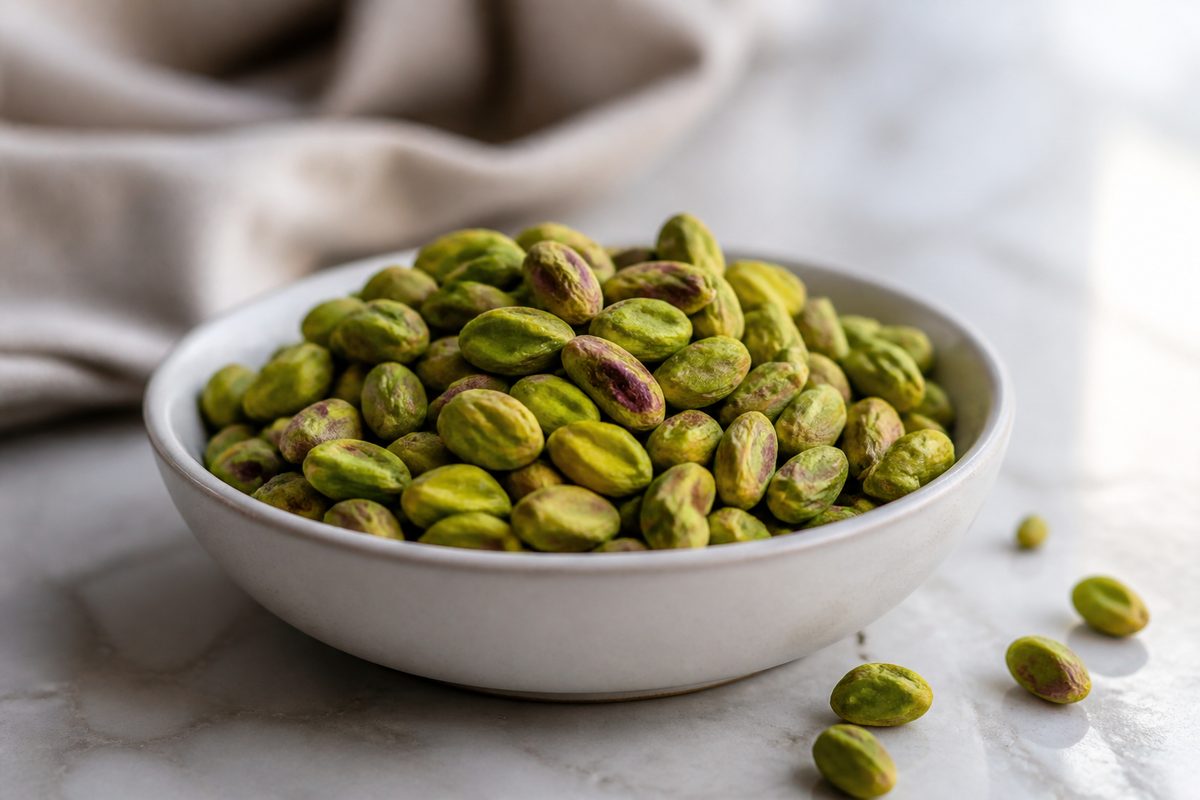
Yes — pistachios can worsen bloating. They are one of the nuts that sit on high-FODMAP lists, so leftover oligosaccharides can ferment in the colon. Among foods linked to bloating in Eat Smart Kiwi community data, pistachios rank #115.
That is a lower mid-table rank — not a top trigger. The chemistry is still real. A few kernels on yoghurt is a different experiment from a big bowl in front of the TV, and pistachio ice cream or baklava is not the same log as the nut. Almond milk is a separate food: a watery, strained drink, not a handful of whole nuts.
Why pistachios can cause bloating
FODMAP food tables list pistachios among nuts that supply fermentable oligosaccharides — in that source, they sit with fructans. Humans do not fully break those short-chain carbohydrates in the small intestine, so they reach the colon, where bacteria ferment them. Gas and extra fluid stretch the bowel. That stretch is felt as bloating and wind.[1]
People with IBS often feel the same gas more strongly. Lowering overall FODMAP intake has been shown to reduce IBS bloating and wind.[2]
A handful of pistachios is also energy-dense fat. Higher-energy, fattier snacks leave the stomach more slowly than a light bite, so the upper gut can stay fuller and tighter on top of later fermentation.[3] That is a heavy snack, not proof that pistachios ferment like beans.
Chickpeas and hummus rank higher for bloating in this community. Those are classic GOS pulses. Pistachios are a nut, logged separately. Mixing pistachios with onion, garlic, or a pulse dip stacks FODMAPs on one plate.[2]
Salted pistachios add a sodium load. For the salt pathway, see does salt cause bloating?. Do not treat Avicenna notes or a traditional-Persian-medicine flatulence review as a pistachio trial. Extra water is not a proven way to “flush” nut fibre.
Who is most likely to notice it
- IBS and FODMAP sensitivity — the same oligosaccharide load can feel much more uncomfortable.[2]
- Anyone eating a large handful — more fermentable carbohydrate and more fat in one sitting.[1][3]
- Anyone stacking — pistachios plus onion, garlic, hummus, or other high-FODMAP extras.[2]
- People jumping from almost no nuts to a big serve — a TV bowl after weeks without pistachios is a bigger hit than a few kernels you already eat often.
You do not need a diagnosis to notice it. You also do not need to drop every nut if the salt, the mix, or the rest of the plate is doing more of the work. Tree-nut allergy is a different problem — skip this pair if pistachios swell your lips or throat.
What you can try
- Start with a few kernels, not a bowl — dose matters for FODMAPs.[1]
- Test plain nuts — unsalted, not honey-roasted, and not mixed with cashews or dried fruit.
- Keep the rest of the snack simple — yoghurt or a low-FODMAP fruit is a cleaner test than baklava or ice cream labelled pistachio.[2]
- Compare with another nut — walnuts and macadamias are often treated as gentler FODMAP options; your diary shows whether your gut agrees. Do not treat that as a medical swap list.
- If you use salted pistachios, log the salt — the nut and the sodium are two experiments.
You do not have to give up pistachios. Finding the portion and the extras you tolerate is the practical goal.
Eat Smart Kiwi community data
Among foods linked to bloating in Eat Smart Kiwi community data, pistachios rank #115 — a lower mid-table rank, not a top trigger. Pistachios and bloating also ranks #210 among all food–symptom pairs tracked in the app.
The link is most often seen within about 8 hours of eating pistachios, based on aggregated diary data from about 300 users. These are real-world logging patterns among people tracking digestive health; they are not a clinical trial and do not prove pistachios caused bloating in every case — but they match a high-FODMAP nut, even though pistachios are not among the strongest bloating foods in the app.
Why tracking helps you
A few kernels, a salted bag, baklava, and pistachio ice cream are four experiments. Logging how you ate them next to bloating scores shows whether your pattern is the nut, the portion, the salt — or the rest of the plate.
If you want to see whether pistachios or the extras are driving your bloating, try logging in the Eat Smart Kiwi food and symptom tracker.
Summary
Pistachios can worsen bloating because leftover oligosaccharides ferment in the colon, and a fatty handful can sit heavily as well. They show up in Eat Smart Kiwi tracking, but they are not a top bloating food. Smaller serves, a simpler snack, and your own diary are practical next steps.
This article is for general information only and is not medical advice. If bloating is severe, painful, or persistent, see a doctor. Do not eat pistachios if you have a tree-nut allergy.