Do chickpeas cause bloating?
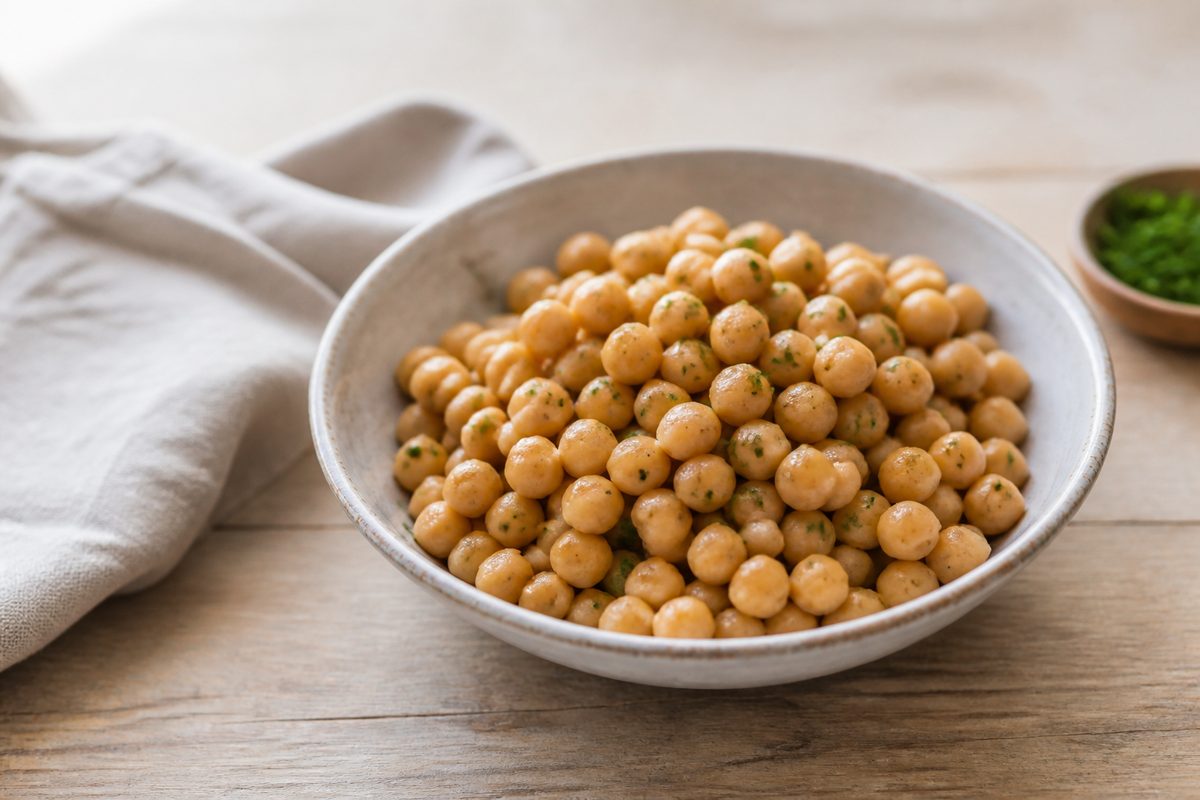
Yes — chickpeas can worsen bloating. They carry fermentable sugars that gut bacteria turn into gas. Among foods linked to bloating in Eat Smart Kiwi community data, chickpeas rank #102.
That is a lower mid-table rank — not a top trigger. The chemistry is still real. A few chickpeas on a salad is a different experiment from a large curry, and hummus, falafel, and roasted chickpeas are logged separately. In this community, hummus and falafel both rank higher for bloating than chickpeas themselves — often because garlic, onion, frying, or a bigger serve ride along.
Why chickpeas can cause bloating
Chickpeas are rich in galacto-oligosaccharides (GOS) — mainly raffinose, stachyose, and ciceritol. Humans do not make the enzymes to break these sugars down in the small intestine, so they reach the colon, where bacteria ferment them and produce gas. That stretch is felt as bloating and wind.[1]
Among the pulses tested in one composition study, raw chickpeas sat at the high end for total oligosaccharides. Soaking lowered that load. Cooking the soaked chickpeas did not reliably cut oligosaccharides further — amounts were unchanged or even rose, likely because other solubles washed out and concentrated what was left. Soaking and discarding the water is useful. Boiling is not a second guarantee.[1]
People with IBS often feel the same gas more strongly. Lowering FODMAP intake has been shown to reduce IBS bloating and wind.[2]
A chickpea curry or salad often adds onion and garlic — extra fructans, another FODMAP. That is a stacked plate, not “just chickpeas.”[2]
Chickpeas are not unusually high in fructans on their own. The usual fermentable story is GOS. Fibre adds bulk; it is not the same as those oligosaccharides.
In 21 healthy men, 100 g dry weight of Kabuli chickpeas a day for 28 days (versus potato) produced only minor changes in how often or how badly they noticed flatulence. Overall gut-function scores did not shift.[3] That is daily chickpea in people without IBS, not a one-off huge curry. Eat Smart Kiwi diaries can still show more bloating after chickpeas. Both can be true: a sensitive gut, a large serve, or onion and garlic in the pot are a different experiment from a measured chickpea feed.
Who is most likely to notice it
- IBS and FODMAP sensitivity — the same fermentation can feel much more uncomfortable.[2]
- Anyone stacking — chickpeas plus onion, garlic, hummus, or a wheat wrap.[2]
- Large serves — more GOS in one sitting.[1]
- People jumping pulses overnight — a big bowl after weeks without chickpeas is a bigger hit than the same food after regular small serves.[3]
You do not need a diagnosis to notice it. You also do not need to drop every pulse if the curry spices or the hummus are doing more of the work.
What you can try
- Start small — a sprinkle on a salad, not a whole stew, then build up if you want them often.[3]
- Soak dried chickpeas and discard the water — soaking lowers oligosaccharides; cooking in fresh water is the usual next step, but cooking is not a further GOS wipe for chickpeas.[1]
- Rinse tinned chickpeas — some oligosaccharides sit in the liquid; discard it.
- Keep the pot simple — test chickpeas without onion or garlic so you can see what actually drives your bloating.[2]
- Log hummus and falafel separately — those plates are different foods in the app.
You do not have to give up chickpeas. Finding the portion, recipe, and extras you tolerate is the practical goal.
Eat Smart Kiwi community data
Among foods linked to bloating in Eat Smart Kiwi community data, chickpeas rank #102 — a lower mid-table rank, not a top trigger. Chickpeas and bloating also ranks #188 among all food–symptom pairs tracked in the app.
The link is most often seen within about 8 hours of eating chickpeas, based on aggregated diary data from about 400 users. These are real-world logging patterns among people tracking digestive health; they are not a clinical trial and do not prove chickpeas caused bloating in every case — but they match chickpea GOS chemistry, even though healthy men in a daily-chickpea trial noticed only minor wind.
Why tracking helps you
Tinned versus soaked-and-boiled, a salad sprinkle versus a curry, chickpeas alone versus chickpeas with onion and garlic, and an occasional serve versus pulses most days all change the picture. Logging how you ate them next to bloating scores shows whether your pattern is the chickpea, the portion, or the rest of the plate.
If you want to see whether chickpeas or the curry extras are driving your bloating, try logging in the Eat Smart Kiwi food and symptom tracker.
Summary
Chickpeas can worsen bloating because leftover GOS ferment in the colon. They show up in Eat Smart Kiwi tracking, but they are not a top bloating food — hummus and falafel rank higher. Soaking, smaller portions, simpler recipes, and your own diary are practical next steps.
This article is for general information only and is not medical advice. If bloating is severe, painful, or persistent, see a doctor.