Does bacon cause bloating?
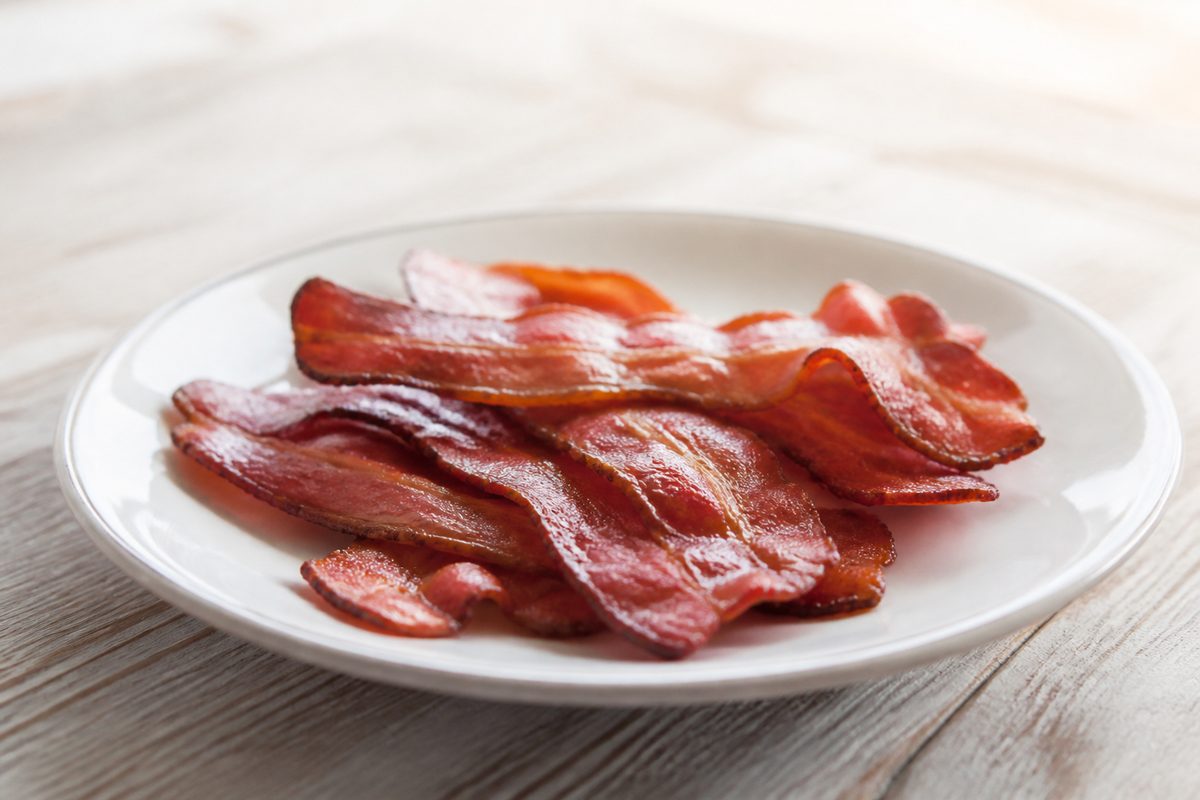
Yes — bacon can worsen bloating. It is a fatty, salty cured meat, not a FODMAP vegetable. Among foods linked to bloating in Eat Smart Kiwi community data, bacon ranks #105.
That is a lower mid-table rank — not a top trigger. About 1,000 people still log the pair, so the pattern is common enough to take seriously, but it is not among the strongest bloating foods in the app. French fries and salt both rank much higher. A rasher on its own is a different experiment from a greasy cooked breakfast with eggs, toast, beans, and coffee.
Why bacon can cause bloating
Bacon is not a fibre-and-oligosaccharide story. Plain pork is low in FODMAPs. Honey-glazed or maple bacon is a slightly different plate; the usual load is fat and salt.
Fat slows the stomach. Higher-energy, fattier meals leave the stomach more slowly than lighter ones. The upper gut stays fuller for longer — a heavy, tight feeling many people log as bloating.[1] Several rashers fried in their own fat is a denser energy load than a single rasher crumbled on a potato.
Salt can puff you up in a different way. In a feeding trial, higher sodium raised the risk of abdominal bloating on both a high-fibre diet and a lower-fibre control diet. That is extra fluid retention and stretch, not fermenting cabbage sugars. The authors did not measure how fast the stomach emptied, and they did not test bacon.[2] See does salt cause bloating?.
Bacon is often eaten with other bloating suspects. Baked beans, fried bread, onion in a burger, and a large volume of food are not “just bacon.” A community survey that lists fatty foods among perceived bloating triggers is not a physiology trial of duodenal fat trapping gas, and it is not a bacon study.
Do not treat Avicenna notes, a lipid–colon hypersensitivity paper, or a bloating “management cascade” as a rasher protocol. Baking bacon on a rack can drip fat off; that is a smaller energy load, not a proven anti-bloat method.
Who is most likely to notice it
- People sensitive to fatty meals — the same slow-emptying story as other greasy plates.[1]
- Anyone stacking salt — bacon plus a salty takeaway or a shaker-heavy breakfast.[2]
- Large serves — several rashers as the main event, not a garnish.
- People blaming bacon for the whole cooked breakfast — beans, toast, and coffee are separate logs.
You do not need a diagnosis to notice it. You also do not need to drop every rasher if the beans or the salt on the rest of the plate are doing more of the work.
What you can try
- Shrink the serve — one rasher is a different fat and sodium load from a pile.[1][2]
- Let fat drip off — baking on a rack or blotting is a lower-energy test than frying in the pan.[1]
- Keep the rest of the plate quieter — skip extra salt, and test bacon without baked beans or a garlic bun.
- Do not chug water to “flush salt” — sipping is fine; a water load is not a sodium antidote.
- Compare in your tracker — baked versus fried, one rasher versus several, and bacon versus french fries or extra salt, shows whether your pattern is the meat, the fat, or the rest of breakfast.
You do not have to give up bacon. Finding the amount and plate you tolerate is the practical goal.
Eat Smart Kiwi community data
Among foods linked to bloating in Eat Smart Kiwi community data, bacon ranks #105 — a lower mid-table rank, not a top trigger. Bacon and bloating also ranks #195 among all food–symptom pairs tracked in the app.
The link is most often seen within about 8 hours of eating bacon, based on aggregated diary data from about 1,000 users. These are real-world logging patterns among people tracking digestive health; they are not a clinical trial and do not prove bacon caused bloating in every case — but they match a fatty, salty meat sitting with more bloating for many people, even though bacon is not a top-ranked bloating food.
Why tracking helps you
A garnish versus a pile, oven versus pan, maple glaze versus plain, and bacon on its own versus a full cooked breakfast all change the picture. Logging how you ate it next to bloating scores shows whether your pattern is fat, salt, or the rest of the plate.
If you want to see whether bacon or the breakfast extras are driving your bloating, try logging in the Eat Smart Kiwi food and symptom tracker.
Summary
Bacon can worsen bloating because it is fatty and salty, not because it is a FODMAP vegetable. It shows up in Eat Smart Kiwi tracking, but it is not a top bloating food — fries and salt rank higher. Smaller serves, less dripping fat, a simpler plate, and your own diary are practical next steps.
This article is for general information only and is not medical advice. If bloating is severe, painful, or persistent, see a doctor.