Does beetroot cause bloating?
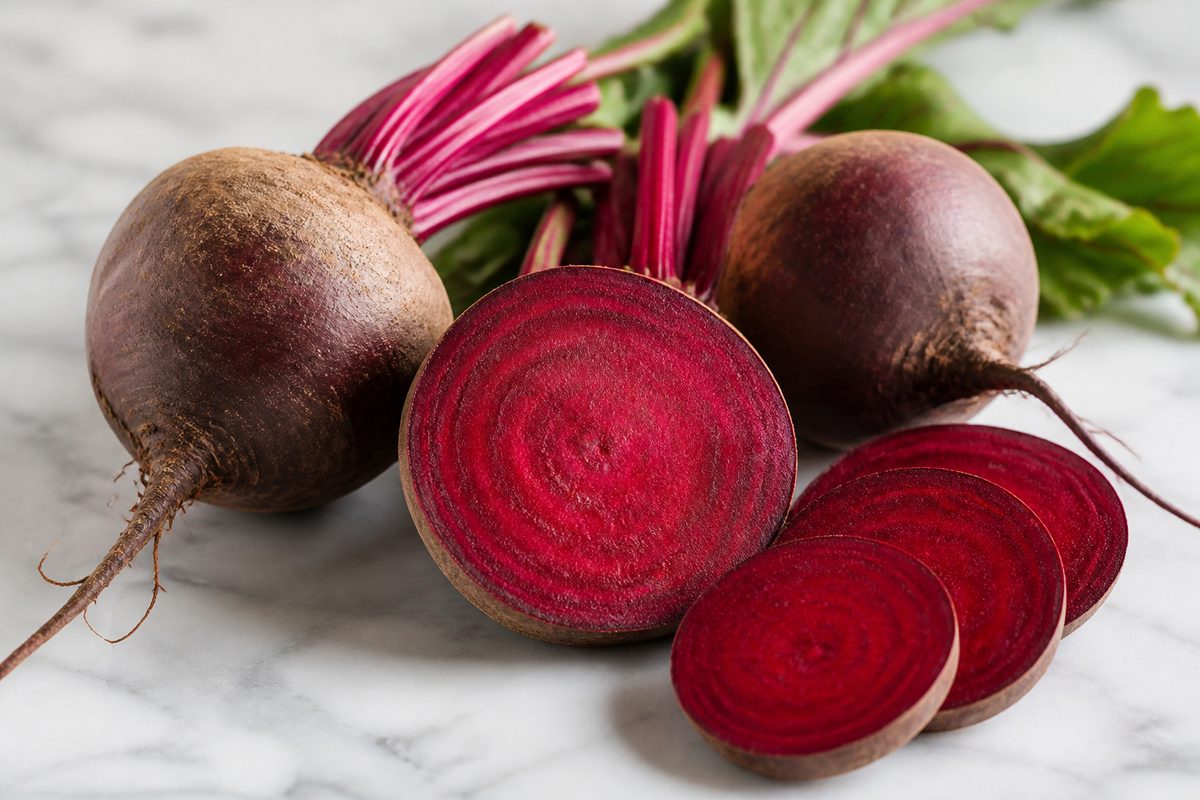
Yes — beetroot can worsen bloating. It is a nutritious root vegetable, but leftover oligosaccharides and fibre can ferment in the colon. Among foods linked to bloating in Eat Smart Kiwi community data, beetroot ranks #133.
That is a lower mid-table rank — not a top trigger. About 300 people still log the pair. Beetroot and gas is the stronger community story: wind ranks #21 among gas foods. Passing more air and feeling tight and stretched are not the same complaint.[3]
A few thin slices in a salad is a different experiment from a large roast, pickled beetroot, or a concentrated juice.
Why beetroot can cause bloating
FODMAP food tables list beetroot among vegetables that supply fructans. Humans do not fully break those oligosaccharides down in the small intestine, so they reach the colon. Bacteria ferment them and produce gas. Unabsorbed carbohydrate can also draw water into the bowel. Gas plus extra fluid stretches the gut wall — felt as bloating.[1][2]
Do not treat beetroot as a GOS pulse like peas or lentils. The everyday FODMAP story here is the root vegetable, not a bean.
Fibre adds bulk. A sudden large serve after a low-vegetable diet means more fermentation in one sitting. That is not a reason to “flush fibre with water.”
People with IBS often feel the same stretch more strongly. Lowering FODMAP intake has been shown to reduce bloating and wind.[2]
What sits next to the beetroot often matters. Salad onion, garlic, a wheat wrap, or a beetroot-and-bean mix stacks more FODMAPs on the same plate.[2]
In a crossover in healthy adults, extra gas passages and the feeling of bloating did not always travel together. Psyllium made people feel bloated without extra flatus; lactulose raised how often they passed wind.[3] That split fits this community: beetroot shows up more clearly for gas than for bloating.
Do not treat a UK food-perception survey as a beetroot trial. Do not treat a DASH-sodium bloating paper as beetroot fibre. Do not treat Iranian traditional-medicine herbal reviews as a peppermint-tea protocol for this pair.
Who is most likely to notice it
- IBS and FODMAP sensitivity — the same fermentation can feel much more uncomfortable.[2]
- Anyone drinking a large juice — more concentrated oligosaccharides than a garnish.[1]
- People jumping fibre overnight — a whole roasted beetroot after weeks without is a bigger hit than a slice you already eat often.
- Anyone stacking — beetroot plus onion, garlic, or beans.[2]
You do not need a diagnosis to notice it. You also do not need to drop every root vegetable if the juice, the pickle, or the onion is doing more of the work.
What you can try
- Start with a few slices, not a bowl — dose matters for FODMAPs.[1]
- Compare cooked, pickled, and juice — they are different loads. Drain pickled beetroot if you want a cleaner test.
- Keep the rest of the plate simple — skip onion and garlic while you test the beetroot.[2]
- Log gas as well as bloating — wind ranks higher for this food in the app.[3]
- Compare in your tracker — salad versus roast versus juice, and beetroot versus the extras, shows whether your pattern is the root, the portion, or the rest of the plate.
You do not have to give up beetroot. Finding the amount and form you tolerate is the practical goal.
Eat Smart Kiwi community data
Among foods linked to bloating in Eat Smart Kiwi community data, beetroot ranks #133 — a lower mid-table rank, not a top trigger. Beetroot and bloating also ranks #248 among all food–symptom pairs tracked in the app.
The link is most often seen within about 8 hours of eating beetroot, based on aggregated diary data from about 300 users. These are real-world logging patterns among people tracking digestive health; they are not a clinical trial and do not prove beetroot caused bloating in every case — but they match a FODMAP root vegetable, even though beetroot is a much clearer gas food than a bloating food in this community.
Why tracking helps you
A garnish, a roast tray, pickled slices, and a sports-style juice are different experiments. Logging how you ate beetroot next to bloating scores — and next to gas, if you also feel windy — shows whether your pattern is the vegetable, the portion, or the rest of the plate.
If you want to see whether beetroot or the extras are driving your bloating, try logging in the Eat Smart Kiwi food and symptom tracker.
Summary
Beetroot can worsen bloating because leftover oligosaccharides ferment in the colon. It shows up in Eat Smart Kiwi tracking, but it is not a top bloating food — the same vegetable ranks much higher for gas. Smaller serves, a simpler plate, and your own diary are practical next steps.
This article is for general information only and is not medical advice. If bloating is severe, painful, or persistent, see a doctor.