What foods cause gas?
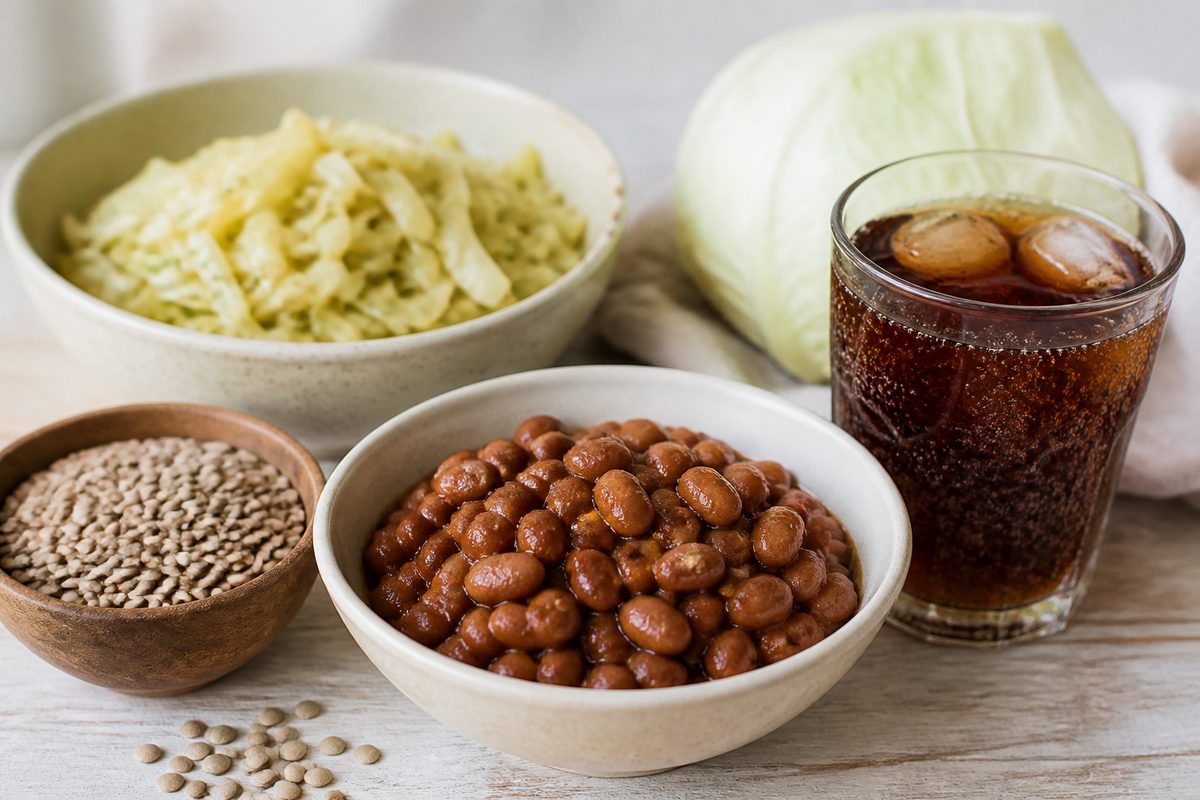
Some foods are much more likely to cause gas (wind) than others. Common culprits include onions, beans and other pulses, cauliflower, some fruit, beer, and lactose-containing dairy.
Gas usually comes from carbohydrates that are not fully absorbed in the small intestine. Gut bacteria ferment them in the colon and produce hydrogen, carbon dioxide, and sometimes methane. Fizzy drinks can also add swallowed bubbles before fermentation even starts.[1]
Here are some of the foods most commonly associated with gas, why they may cause it, and what Eat Smart Kiwi users have found in their own food and symptom diaries. Bloating is a related feeling — tightness rather than wind — and has its own page: foods that cause bloating.
Onions
Onion is a very common trigger for gas and IBS wind. Garlic is the same chemistry, even though we have not given garlic its own gas article.
Both are high in fructans, a type of fermentable carbohydrate (FODMAP). Fructans are not completely absorbed in the small intestine, so they reach the colon where bacteria ferment them and produce gas.[1]
Onion is also one of the stronger foods associated with increased gas in Eat Smart Kiwi diaries.
Read more: Does onion cause gas?
Beans, lentils and tofu
Pulses are well known for causing wind. Humans do not fully digest galacto-oligosaccharides (GOS), so bacteria ferment them and produce gas.
Eat Smart Kiwi has individual pages for lentils and tofu. A couple of spoonfuls in a soup is a different load from a large bowl of dahl with onion and garlic.
Cauliflower and mushrooms
Cauliflower and mushrooms can cause wind because of fibre and fermentable carbohydrates. Cauliflower and many common mushrooms are high in the polyol mannitol, which many people absorb poorly.
Larger raw servings are more likely to cause symptoms than a smaller cooked portion.
Apple, pear and dried fruit
Some fruit combines excess fructose with sorbitol — both FODMAPs that often reach the colon unabsorbed.
Apple, pear, and dried apricots all fit that pattern. Half a fruit is a different load from juice, two large pieces, or fruit stacked with sugar-free gum.
Read more: Does apple cause gas?
Beer and fizzy drinks
Beer combines several causes of wind. It is carbonated, so you swallow gas as you drink. Beers made from wheat, barley, or rye can also carry fermentable carbs.[2]
Beer is among the stronger gas associations in Eat Smart Kiwi diaries.
Read more: Does beer cause gas?
Wine
Red wine is not carbonated. Residual sugars, alcohol, and what you drink it with may still contribute to wind.
Cheese, ice cream and other dairy
If you do not fully digest lactose, that sugar reaches the colon and ferments into gas.[3]
Lactose varies a lot between dairy foods. Hard, aged cheese is often much lower in lactose than milk or ice cream. Cheese can still cause wind from leftover lactose in softer types, or from a high fat load.
Protein bars
The protein is often not the main issue. Many protein bars are sweetened with polyols (sugar alcohols), bulked with isolated fibres such as inulin, or made with whey that still contains lactose — all of which can ferment.
Tomato, salsa and mixed plates
Salsa is often less about tomato than about raw onion and garlic, plus chips on the side. Salad is a mixed plate — lettuce, cabbage, onion, beans, and dressing logged under one name.
Tomato itself ranks highly for gas in Eat Smart Kiwi diaries even though clinical guides usually treat ordinary tomato as low-FODMAP. That is a clue, not proof that a slice of tomato is a classic FODMAP bomb.
What about grapes, potato and similar foods?
Not every food associated with gas is a classic high-FODMAP food.
Eat Smart Kiwi diaries also show associations with grapes, potato, sweet potato, chocolate, and french fries. Grapes and potato are generally treated as well tolerated in ordinary portions.
That does not necessarily mean these foods directly cause wind. Portion size matters, foods are rarely eaten alone, and people who frequently eat a particular food will have many opportunities to record symptoms afterwards. Observational diary associations are useful clues rather than proof that a food is a trigger.
Other foods associated with gas
We've also analysed gas after other foods recorded by Eat Smart Kiwi users, including:
Each page compares the pattern seen in food and symptom diaries with what published research suggests about the food.
Foods that may help with gas
Some foods in Eat Smart Kiwi diaries are associated with less gas rather than more.
Examples include almond milk, lactose-free milk, porridge, hot water, poached eggs, and cinnamon. Vitamin D3 also sits with less gas in a smaller set of diaries — it is a supplement, not a food, and not a proven wind medicine.
These associations don't mean the foods are treatments for gas. In some cases they may simply be alternatives to foods that are more likely to cause symptoms — almond milk instead of cow's milk, or eggs instead of a high-FODMAP breakfast.
How to work out which foods cause your gas
A list of common triggers can give you somewhere to start, but wind varies enormously between people.
If you're trying to identify your own triggers:
- Change one thing at a time rather than cutting out many foods together.
- Pay attention to portion size as well as the food itself.
- Remember that several fermentable foods in the same meal or day can add up.
- Consider whether wind happens soon after a fizzy drink or hours later after a bean-heavy meal.
- Keep track of foods and symptoms so you can look for patterns over time.
Find your own gas triggers
Eat Smart Kiwi is a food and symptom tracker designed to help identify relationships between what you eat and how you feel.
Log your meals and gas, and Eat Smart Kiwi looks for associations between foods and your subsequent symptoms — including patterns from the hour after a meal through to a week later. You can also compare your results with patterns found across other users.
You can keep a diary for free, with more detailed analysis available on the paid plan and free trial.
If digestive symptoms are your main concern, see our food diary for IBS, foods that cause bloating, or our guide to keeping a food and symptom diary.
Get started in the browser, or install the app


References
- Halmos EP, et al. A diet low in FODMAPs reduces symptoms of irritable bowel syndrome. Gastroenterology. 2014.
- Camps G, de Graaf K, Smeets PAM. Men and women differ in gastric fluid retention and neural activation after consumption of carbonated beverages. J Nutr. 2018.
- Misselwitz B, et al. Update on lactose malabsorption and intolerance: pathogenesis, diagnosis and clinical management. Gut. 2019.
This article is for general information only and is not medical advice. If gas is severe, persistent, or accompanied by unexplained weight loss, blood in your stool, or symptoms that wake you at night, talk to a healthcare professional.