How to keep a food and symptom diary
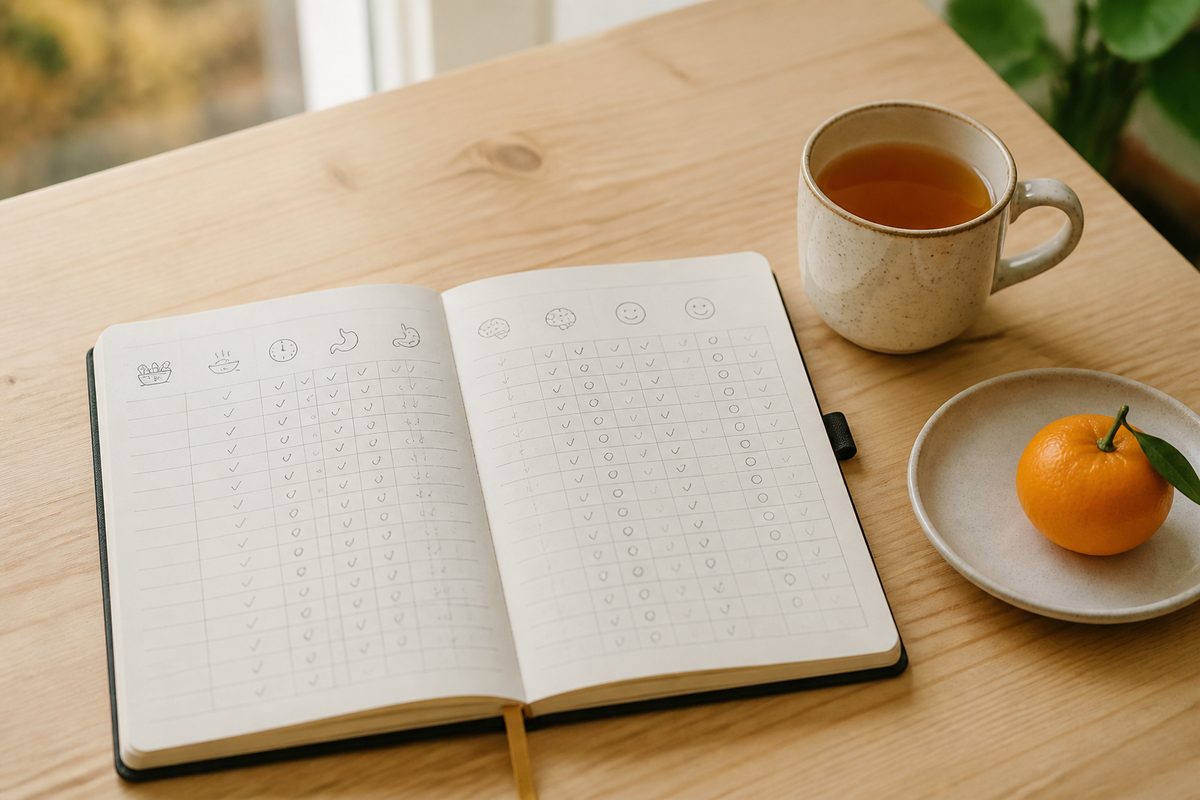
Finding food triggers is personal. A list of common allergens is not a map of your gut. A food and symptom diary puts meals and how you feel on one timeline, because reactions can be delayed, dose-dependent, or mixed up with stress and sleep. That is also what a food intolerance tracker is: not a blood test, just a careful log. Do not start by cutting half your diet — log a typical couple of weeks first. The method works in a notebook; an app just makes the pattern-finding easier.
Get started in the browser, or install the app


Why a food and symptom diary helps
Many food reactions are not immediate. Bloating, pain, fatigue, headaches, or a change in bowel habit can show up hours later — sometimes the next day. By then it is easy to blame the last thing you ate, or to miss a food you eat often.
A diary is an external memory. Written down, meals and symptoms sit on the same timeline, so you can look back over days instead of guessing. That helps you:
- Spot delayed patterns you would not connect in the moment
- See whether a larger portion, a sauce, or a food combination matters more than the food on its own
- Notice what helps — not only what hurts — including days you feel well
- Take a clearer record to a GP or dietitian instead of a vague “I think dairy does it”
- Avoid cutting out half your diet on a hunch, which can make eating more stressful and less nutritious
Diaries are used for IBS and other gut symptoms, but they are just as useful for energy, migraines, skin, joint pain, congestion, mood, and sleep — anything that might line up with food.
What to write down
You do not need a laboratory log. Enough detail to reconstruct the day is the aim.
Food and drink
- Meals, snacks, and drinks, with approximate times
- Main ingredients when you know them — garlic in a sauce, milk in coffee, and dressings are easy to forget
- A rough portion (small / usual / large is fine; weighing is optional)
- How it was prepared if that might matter (fried versus boiled; whole fruit versus juice)
Symptoms
- What you felt — for example bloating, pain, urgency, constipation, diarrhoea, fatigue, headache
- When it started, and how severe it was on the same scale each time (0–10 works well)
- How long it lasted, if you know
Context that often changes the picture
- Stress, sleep, and exercise
- Medications and supplements
- Menstrual cycle, if relevant
- Bowel movements and stool form, if gut symptoms are the reason you are tracking
Log ordinary days and good days as well as flare-ups. A diary made only of bad evenings is harder to interpret.
How to keep a diary you will actually use
Most food diaries fail because they are too fussy. Consistency beats perfection.
- Record soon after eating, or photograph the plate and log later the same day.
- Log symptoms when they happen — not as a Sunday reconstruction of the whole week.
- Keep the notebook or phone where you eat, and set a reminder if you forget.
- Aim for most days, including at least one weekend day. Routines change on Saturday.
- In the first two weeks, keep eating as you normally do unless a clinician has asked you to change. You need a typical picture first.
- Once a week, skim the log. Looking daily can turn into rumination; a weekly review is enough to see repeats.
If you miss a meal, write what you remember. Gaps are normal. An incomplete diary is still more useful than none.
How long should you keep one?
Two to four weeks of reasonably complete logging is the usual first pass. That is long enough to cover weekdays and weekends, a few repeats of common foods, and symptoms that lag behind meals. Some people notice useful clues in one to two weeks; others need longer, especially if they eat a varied diet or symptoms are infrequent.
If you are working with a dietitian, ask how long they want the record. For delayed gut symptoms, looking back 24–72 hours before a flare is often more informative than looking only at the last bite.
How to read it without jumping to conclusions
- One bad evening after pizza is not proof that pizza is the problem. Look for repeats.
- Check the hours before a symptom, not only the last thing you ate.
- Portion and pairing matter. A food that is fine as a side can be a problem as a large serving, or with garlic, onion, or a creamy sauce.
- Stress, poor sleep, alcohol, and the menstrual cycle can look like a food trigger. Note them so you do not over-blame dinner.
- Avoid black-and-white “good food / bad food” lists. Tolerance is often a threshold, not an on/off switch.
Share the diary with a health professional if symptoms are severe, persistent, or you are considering a strict elimination diet. Unexplained weight loss, blood in the stool, or symptoms that wake you at night need medical review — a diary is not a substitute for that.
Notebook, spreadsheet, or an app?
A paper notebook is a perfectly good start: private, no setup, and easy to take to an appointment. A spreadsheet adds structure if you like columns. Both get harder when you want to compare a symptom with meals from yesterday or the day before.
If you use an app, look for:
- Fast food entry, so logging survives a busy week
- Flexible symptoms — not only IBS, if that is not your only issue
- Analysis that looks across different time windows, because triggers are not always immediate
- Phone and web, so you can log at the table and review on a bigger screen
How Eat Smart Kiwi helps
Eat Smart Kiwi is a food and symptom diary built for this kind of detective work. You log what you eat and rate how you feel; the app looks for correlations between foods and symptoms across different time windows — including delayed patterns that are hard to see on paper.
Analysis can surface ingredients and food groups, not only whole meals. Community data from other users can bolster insights while your own log is still short. You can export the diary as a printable PDF for an appointment, or as CSV if you want the raw log. Keeping a diary is free; deeper analysis is available on a paid plan with a free trial.
Tracking IBS? See food diary for IBS.
Get started in the browser, or install the app
Common questions
Do I have to weigh every portion?
No. Approximate amounts are enough. Note “large” versus “small” when a bigger serving might matter.
Should I start an elimination diet at the same time?
Usually not, unless a clinician has asked you to. A baseline of your normal eating is more informative than a diary kept while you have already cut ten foods.
Is this only useful for IBS?
No. The same method is used for reflux, migraines, fatigue, skin, joint pain, congestion, and mood — any symptom that might follow food.
How is this different from a calorie-counting food diary?
A calorie diary asks “how much did I eat?” A food and symptom diary asks “what did I eat, and how did I feel?” You can ignore calories entirely if weight is not the question.
This article is general information, not medical advice. See a doctor or registered dietitian before making large diet changes, especially if you have ongoing or unexplained symptoms.