Does blueberry help with acne?
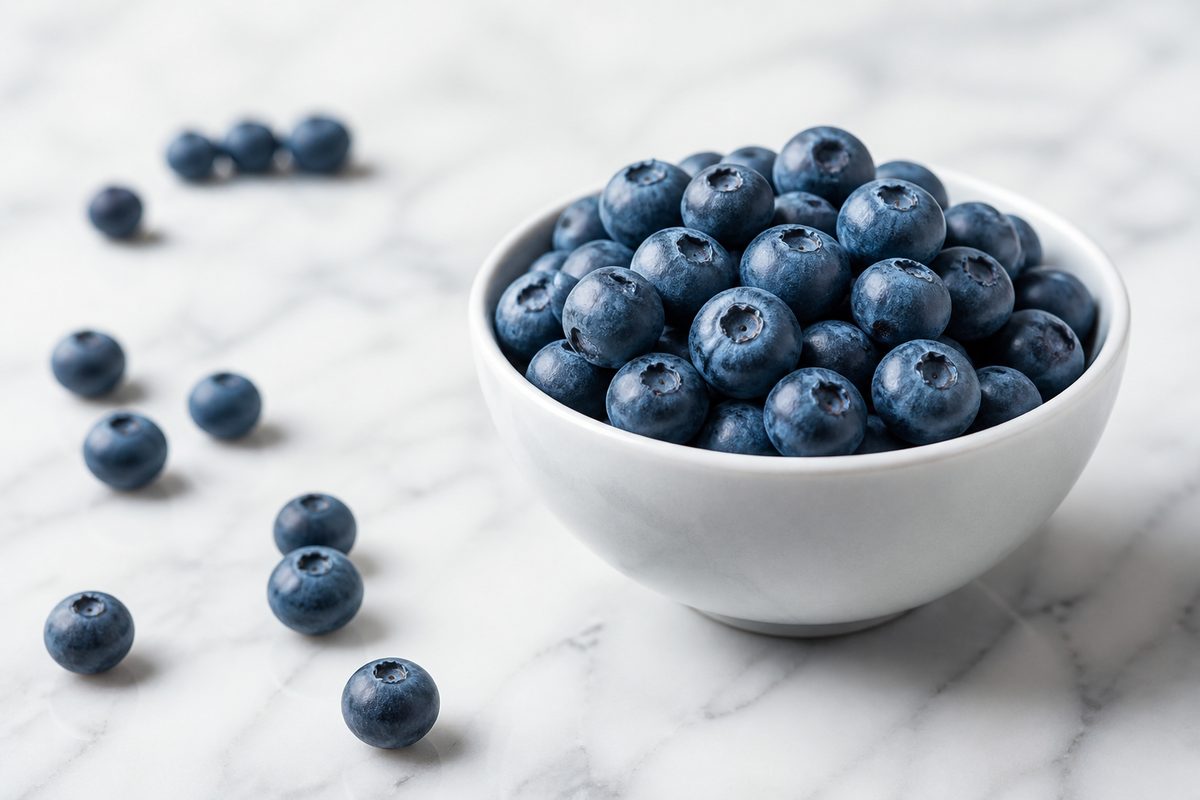
Yes — blueberry can sit with quieter acne scores for some people. Among foods linked to acne in Eat Smart Kiwi community data, blueberry ranks #1 — and the direction is that blueberry helps.
That is a strong community rank from about 300 diaries, not a handful that treats cystic acne or replaces a dermatologist. There is no clinical trial of ordinary blueberry for acne in the eight hours after a snack. Blueberries (plural) is a different log in the app — see congestion, muscle pain, and gas.
Why blueberry might help
The honest picture is: Eat Smart Kiwi users who log blueberry often report lower acne scores in the following eight hours, and the skin-specific biochemistry is still a guess.
A new spot does not form or fade in an afternoon. Comedones and inflammatory papules play out over days. An eight-hour score is more “how angry existing spots feel,” or berries logged on a clearer-skin day, than proof that anthocyanins emptied a pore.
Blueberries are a lower-glycaemic fruit. Reviews and trials of diet and acne talk about glycaemic load and dairy — not a punnet. In a 12-week randomised trial, 43 young men with acne on a low-glycaemic-load diet had fewer total lesions than those on a high-glycaemic-load diet, and they also lost a little weight and improved insulin sensitivity.[1] That is a whole eating pattern over months, not eight hours of fruit, and the diet was not “add blueberries.”
So a practical story that can still match the diaries is the swap: a handful of blueberry instead of biscuits, chocolate, or a sugary drink. That is the snack you did not eat, not a proven sebum-regulating phytochemical. Do not treat vitamin C in berries as a spot-healing dose. Do not treat an anthocyanin-and-skin-ageing review, ozone-exposed skin explants, or a topical blueberry hydrogel as this pair.
A muffin, a sweet smoothie, and plain fruit are different loads. Frozen berries are a normal food, not an “acne-fighting” concentrate.
Blueberry will not replace benzoyl peroxide, prescribed retinoids, or medical care. Severe, scarring, or cystic acne needs a doctor.
Who is most likely to notice a benefit
- People already eating blueberry as a usual snack — that is what the diaries measure, not a 12-week low-GI meal plan.[1]
- Anyone swapping it for a high-glycaemic sweet snack — the contrast may be the food you did not eat.[1]
- People scoring how red or tender existing spots feel the same day — that fits eight hours better than “prevents new breakouts.”
- Anyone hoping a daily punnet treats hormonal or cystic acne — there is no such trial.
Stop if blueberry swells your lips or throat (oral allergy is a reason to skip, not to push the dose).
What you can try
- Eat a normal handful — fresh or frozen, not a sugary muffin that happens to contain berries, and not a 12-week diet protocol copied as blueberry medicine.[1]
- Keep the rest of the snack simple — berries on their own are a clearer test than a smoothie with yoghurt, banana, and oats.
- Do not credit the fruit if you also started a cream or antibiotic — those have their own effects.
- Give a low-glycaemic pattern weeks if that is the experiment you want — lesion counts in the trial were measured after 12 weeks of a whole diet, not one punnet.[1]
- Log blueberry and blueberries separately — they are different foods in the app.
- Compare in your tracker — days with blueberry versus without, and whether the spots are new or already there, shows whether your pattern matches the community trend.
Eat Smart Kiwi community data
Among foods linked to acne in Eat Smart Kiwi community data, blueberry ranks #1 — and the direction is that blueberry helps. Blueberry and acne also ranks #113 among all food–symptom pairs tracked in the app — a lower mid-table overall rank, not a top pair across the whole food–symptom list.
The pattern is most often seen within about 8 hours of eating blueberry, based on aggregated diary data from about 300 users. These are real-world logging patterns among people tracking food and how they feel; they are not a clinical trial and do not prove blueberry reduced acne in every case — but they are the strongest evidence we have for this specific pair, and they sit in a much shorter window than a 12-week diet study.
Why tracking helps you
A handful, a smoothie, a muffin, and “I ate berries on a good-skin day” are different experiments. Logging how you ate blueberry next to acne scores shows whether your pattern matches the community trend — or whether the rest of the diet, hormones, or a cream is doing the work.
If you want to see whether blueberry or the rest of the day is easing your spots, try logging in the Eat Smart Kiwi food and symptom tracker.
Summary
Blueberry often sits with quieter acne scores in Eat Smart Kiwi tracking, and it ranks first among foods linked to that symptom. There is no blueberry-for-acne trial; the honest human evidence is that a low-glycaemic-load diet over 12 weeks can improve acne in young men — a pattern, not a punnet, and not an eight-hour window. A normal handful, your own diary, and usual acne care are practical next steps.
This article is for general information only and is not medical advice. If acne is severe, scarring, painful, or persistent, see a doctor or dermatologist. Do not stop prescribed treatment to eat more fruit.